
socialXR

5th Spring School on Social XR

March 22-25, 2027
Amsterdam, The Netherlands

Apply now!
Welcome Anniversary Edition

Welcome!

We are happy to announce that the 5th edition of the Spring School on Social XR, will take place at CWI (Centrum Wiskunde & Informatica) in Amsterdam. Come join us for the anniversary edition from March 22-25 2027!

Extended Reality (XR) opens up new possibilities for education, manufacturing and cultural heritage. Social XR takes a step further by making these virtual experiences shared. No longer just watching, people meet in the same virtual world, as avatars or volumetric captures of themselves, to communicate and collaborate in real time, even when physically apart.

Creating these virtual worlds requires solving interconnected challenges across the entire Social XR pipeline. We need to understand and model how people behave and relate within them, design intuitive spatial interactions and engineer networks that keep remote experiences seamless and real-time. At the same time, we must ensure these systems are ethical, private, accessible and safe for everyone who uses them. Addressing these challenges demands a deep synergy between computer graphics, networking and systems, signal processing, multimedia, interaction design and the social sciences.
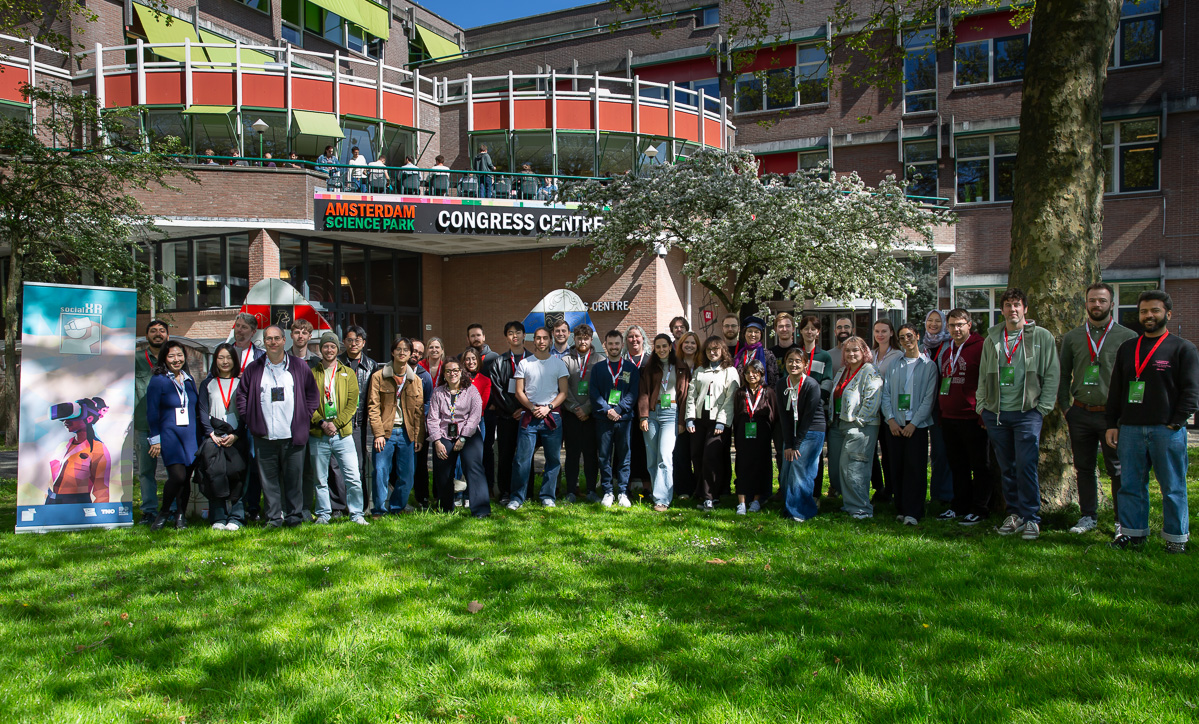
Spring School 2026 group photo

For this reason, the school has followed an interdisciplinary approach since its first edition: we welcome students from technology, social sciences and humanities and bring them together with experts from the same range of fields through talks, discussions and social events.

Join us to explore how Social XR and virtual worlds can make remote togetherness possible and to meet the community shaping them responsibly.

Apply now

Apply now!

We welcome applications from Ph.D. students, post-docs, and master students from various disciplines.

  • 5 ECTS credits
  • For PhD students and postdocs
  • Application deadline: December 3rd, 2026

The success of the Spring School goes beyond the curriculum; it's a testament to the seamless integration of insightful talks, engaging discussions, and well-curated social events. This blend created an environment where learning and networking seamlessly converged.

— Mohammed Faisal, University of Ottawa (participant 2024)

School Scope

Scope

The aim of this school is to learn about Social XR as a new medium for communication and collaboration, from the technology that builds shared virtual worlds to the people who inhabit them. In particular, we focus on the following areas:

  • Social behaviour and presence: how people interact, relate and feel present in shared virtual worlds;
  • Human factors and evaluation: assessing and evaluating experiences and modelling and predicting quality of experience (QoE);
  • Health, wellbeing and behaviour change: using XR to support training, therapy, wellbeing and pro-social behaviour;
  • Avatars, virtual humans and AI: capturing and modelling realistic avatars and their behaviour, including AI-driven social agents;
  • Interaction and multi-sensory experiences: rendering, haptics and new interaction paradigms for immersive experiences;
  • Volumetric video and real-time communication: coding, transmission and distribution of volumetric content, and their optimisation to increase QoE;
  • Ethics, safety and inclusion: ethics by design for responsible Social XR, including privacy, trust and safety, and accessibility.

Target Audience

This school is intended for Ph.D students from different disciplines who are interested in learning more about the mechanics underlying immersive experiences, such as user-centered delivery systems and human perception, as well as volumetric content recording, rendering, and coding. Participants seeking a mixture of theoretical, empirical and practical insights from an interdisciplinary perspective are encouraged to apply.

We also welcome applications from master students and post-docs, as well as professionals and researchers (upon availability).

English is the language of instruction. Attending PhD students will be granted 5 ECTS points for their participation.


Supported by